

Editorial Team· Content Writer
Oct 30, 2026 16 min read 3,019 words
Last Updated: Oct 30, 2026
Quick Summary
The national median in-home care cost in 2026 is $34 per hour, according to A Place for Mom's 2026 state-by-state guide. Your actual in-home care cost depends on your location, the number of hours you need, and the level of support required.
Multiply the hourly rate by weekly hours, then by about 4.33 weeks to estimate a monthly total.
Costs differ by state, and metropolitan areas often cost more than rural areas.
Hours per week is the biggest driver of your total bill, so plan for current needs and review them over time.
Ask each provider what its rate includes, plus any minimum shift lengths and add-on charges.
Original Medicare generally does not cover ongoing non-medical care at home, so check Medicaid waivers and long-term care policies.
Table of Contents
Paying for In-Home Care: Savings, Payment Options and Planning
Estimating Your Family's Care Budget Before You Request a Quote
Why In-Home Care Cost Breakdowns Matter for Your Family
Choosing in-home care is one of the biggest financial decisions a family makes. Yet many families start their search without a clear picture of what care actually costs. At Mutiara Elite, we believe a clear cost breakdown helps families plan with confidence and care for their loved ones with dignity.
The national median cost of home care in 2026 is $34 per hour, according to A Place for Mom's 2026 state-by-state home care cost guide. Costs vary widely depending on where you live and how much care you need. That range is why a breakdown matters more than a single number.
Here is what a useful cost breakdown helps you answer:
How much does one hour of care cost?
What does a full day or a full month add up to?
Which factors push the price up or down?
What payment options exist?
Families who understand these answers can compare providers fairly and avoid surprises later.
National Median In-Home Care Costs Per Hour, Day and Month
Costs are usually quoted by the hour, but families often think in days and months. Converting the hourly rate makes budgeting easier.
Here is a simple way to see how the math works. Multiply the hourly rate a provider quotes you by the hours you need each day, then by the days in a week, and then by about 4.33 weeks per month. Your actual totals will change with your schedule. A family needing care three mornings a week will spend far less than one needing round-the-clock support.
Remember that the national median is a starting point, not a quote. Ask any provider to confirm their rate for the exact hours you need.
How State and Regional Differences Change Your Budget
Home care prices depend heavily on location. Costs can differ considerably from one state to another. Browse our personal assistance, companionship, meal prep and respite care options to see which services fit your budget. Compare your state's typical rates against your own quotes to build a realistic starting point for your budget.
Keep these regional points in mind:
Metropolitan areas often cost more than rural areas.
Local labor markets set caregiver wages, which drive the hourly rate.
State rules and provider requirements can also affect pricing.
Always ask local providers for their current rates rather than relying only on averages.
Part-Time, Full-Time and 24-Hour In-Home Care Cost
The number of hours you need is the biggest driver of your total bill. Families generally fall into a few common patterns:
Part-time care: A few hours a few days a week, often used for companionship, errands, or meal help.
Full-time care: Regular care across most weekdays, usually 35 to 40 hours a week or more.
Overnight care: Support during the night, often billed at a different rate.
24-hour care: Continuous coverage, usually by a rotating team of caregivers.
For a family using 24-hour care, costs can run many times higher than part-time care. Plan for the level of support your loved one needs now, and review it as needs change. Many families start with part-time care and add hours over time.
Factors That Raise or Lower Your Care Costs
Two families can request care in the same city, need the same number of hours, and still receive quotes that differ. The gap usually comes from a handful of cost drivers that are easy to overlook on a first call. Understanding how each one works helps you ask sharper questions and compare quotes on equal footing.
Infographic flowchart showing factors that influence your in-home care cost while a family reviews a care plan.
The level of need and the tasks involved
Light companionship, errands, and meal preparation generally sit at the base hourly rate. Personal care that involves physical assistance, bathing, dressing, toileting, transferring from bed to chair, and fall prevention, takes more time per task and often carries a higher rate because it requires more training and physical capability. Care for someone living with dementia or another cognitive condition can add another layer, since supervision, redirection, and safety monitoring may need to continue even when no task is being performed.
A practical way to see this: a two-hour visit built around conversation and lunch is priced differently from a two-hour visit that includes a shower, dressing, and a transfer. Ask each provider how they classify your loved one's needs, because that classification is what sets the rate.
Schedule, timing, and minimum shifts
Many agencies price by the hour, but some set a minimum visit length, so a short check-in may be billed as a longer shift. Ask each provider about its policy. Evenings, weekends, and holidays frequently carry premium rates, and overnight or live-in coverage is usually priced on a different structure than daytime hourly care. If your family needs help mainly at breakfast and bedtime, those premium windows can raise the effective hourly cost well above the advertised daytime rate.
Caregiver experience and specialization
Caregivers with specialized training, dementia care, hospice support, mobility assistance, or experience with specific conditions, may command a higher rate. Nurse visits for clinical tasks are a separate service from non-medical care. Ask whether a nurse visit is included, billed separately, or available at all.
The staffing model behind the rate
An agency-employed caregiver and an independently hired caregiver can advertise similar hourly rates but produce very different total costs. With an agency, the rate may bundle several responsibilities, such as payroll, insurance, screening, scheduling, and backup coverage. Ask each provider exactly what its rate includes. When you hire independently, you take on those responsibilities yourself, including tax withholding, insurance, and finding a replacement on short notice. The advertised rate is only the visible part of either arrangement.
Location and local labor conditions
As covered earlier, state and metropolitan medians vary widely. Within a region, dense urban areas often price higher than rural ones because caregiver wages and commuting costs are higher. Local competition among agencies also matters: a market with many providers may price more aggressively than one with few.
Contract terms and add-on charges
This is where final bills most often diverge from the quoted rate. Common charges to ask about include assessment or intake fees, minimum weekly hours, holiday rates, cancellation policies, transportation mileage, supplies, and rate-increase notice. Ask each provider to explain which of these apply.
When you compare quotes, ask each provider for the same information: the base hourly rate, any minimum shift length, and the full list of add-on charges. Quotes built on the same details are easier to compare than headline rates alone.
A family can sometimes lower costs by adjusting the schedule, consolidating tasks into fewer longer visits, or focusing first on the tasks that most affect safety and dignity. Be careful, though, not to cut support so far that your loved one's safety or well-being suffers.
Paying for In-Home Care: Savings, Payment Options and Planning
Families often pay for in-home care using a mix of sources. Common options include:
Personal savings and income
Long-term care insurance policies
Veterans benefits, for eligible veterans and spouses
Medicaid waiver programs, which vary by state
Eligibility rules for public programs differ by state. Visit your state's official Medicaid or aging services website to confirm current programs and requirements.
Planning ahead can make a real difference. Write down your loved one's expected care hours, estimate the monthly total, and identify which payment sources will cover it. If you need affordable options, ask providers about flexible scheduling and the services they offer to match your budget.
Does Insurance Cover Home Care Services?
Insurance coverage for in-home care depends on the type of policy and the level of care needed. Many families are surprised to learn that standard health insurance and original Medicare generally do not cover ongoing non-medical care at home (Home Health Services Coverage).
Here is what to check:
Medicare: Original Medicare generally covers only short-term, medically necessary home health services, not ongoing non-medical care. Check the official Medicare website for current details.
Medicaid: Many states offer home and community-based waiver programs (Home & Community-Based Services 1915(c)). Check your state's official Medicaid office for current eligibility and coverage.
Long-term care insurance: If your loved one has a policy, review its benefit triggers, daily limits, and covered services.
Private pay: Many families cover costs themselves, sometimes combined with other sources.
Contact the insurer directly and ask for written confirmation of what is covered. Our FAQs answer common questions about coverage and payment before you commit. Verify all policy details yourself before making decisions.
In-Home Care vs. Assisted Living: Comparing the Costs
Families often compare in-home care with assisted living. The better choice depends on how much help your loved one needs and how many hours of support are required.
In-home care can cost less when care needs are limited to a few hours a day. It can cost more when round-the-clock support is needed.
Assisted living typically bundles housing, meals, and daily support into one monthly fee, which can be easier to predict.
Compare the total monthly cost for the care level your loved one needs, not just the hourly rate. Include housing, meals, utilities, and extra service charges in your comparison. Many families find in-home care works well for a loved one who wants to stay in familiar surroundings.
Estimating Your Family's Care Budget Before You Request a Quote
Many cost guides stop at the hourly rate. The harder question, and the one that actually determines whether a plan is affordable, is what a specific weekly schedule will cost over a month and a year. This section walks through that math with worked examples so you can build a realistic budget before you call anyone.
Step 1: Build a needs checklist
Before you estimate hours, write down what your loved one actually needs help with. A useful checklist covers:
Activities of daily living: bathing, dressing, grooming, toileting, eating, and transferring
Mobility and safety: walking assistance, fall risk, and home hazards
Supervision: whether someone must be present even when no task is being done, as with dementia
Household tasks: meals, laundry, light cleaning, and errands
Health-related tasks: medication reminders, appointment coordination, and any clinical tasks
Companionship and social contact
Group the tasks by how often they occur, daily, a few times a week, or occasionally. This list becomes the basis for every quote you request.
Step 2: Convert tasks into weekly hours
Estimate the time each task takes, then add it up. A common pattern looks like this:
Morning routine (bathing, dressing, breakfast): 1.5 hours, five days a week = 7.5 hours
Evening routine (dinner, medication reminder, bedtime): 1 hour, five days a week = 5 hours
Weekly errands and appointments: 3 hours
Light housekeeping: 2 hours
That schedule totals about 17.5 hours a week. Round up to 18 to leave room for tasks that run long.
Step 3: Turn weekly hours into monthly and annual totals
A month is not exactly four weeks, it averages about 4.33 weeks. Using that multiplier keeps your estimate closer to what you will actually be billed.
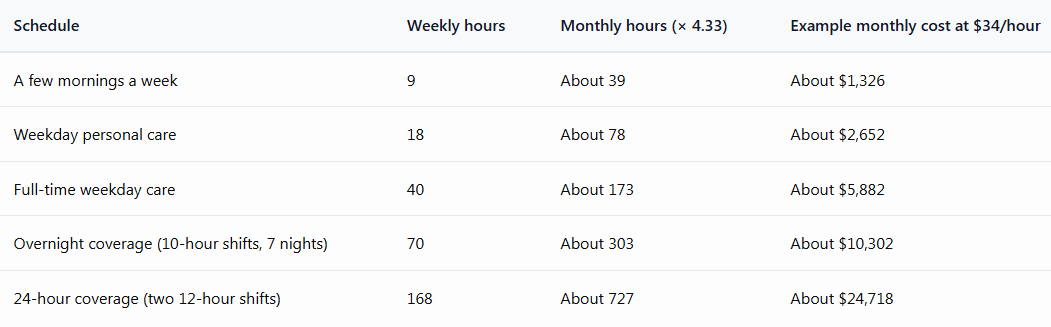
Your local rate, minimum shift rules, and premium charges will change the totals. The point is the shape of the math: small schedule changes compound quickly over a month.
Step 4: Add a buffer for real life
Care needs rarely hold steady. A hospital stay, a family emergency, or a gradual decline in mobility can add hours with little notice. Many families budget some extra above their baseline estimate, and it helps to confirm in advance how a provider handles short-notice additional hours and whether they are billed at a premium rate.
Step 5: Separate short-term from ongoing needs
Respite care, short-term coverage so a family caregiver can rest or travel, is usually budgeted as a block of hours or a few days at a time, not as an ongoing monthly commitment. Ongoing care, by contrast, should be planned against a monthly figure you can sustain. Mixing the two in one budget makes both harder to plan.
Step 6: Match payment sources to the total
Once you have a monthly estimate, list which sources will cover it: personal savings and income, long-term care insurance benefits, veterans benefits for eligible households, and state Medicaid waiver programs where applicable. Eligibility rules vary by state, so confirm current programs and requirements with your state's official Medicaid or aging services office. Knowing the gap between your estimated cost and your confirmed funding is the number that matters most.
Step 7: Plan to revisit the budget
A care budget is not a one-time calculation. Review it whenever hours change, when a new diagnosis or hospital discharge alters needs, or at least once a year. Families often start with part-time care and add hours over time, so building in a regular review keeps surprises small.
The most useful number you can bring to a provider conversation is not the hourly rate, it is your estimated monthly hours and the funding sources you expect to use. Providers can quote far more accurately when they have both.
Organizing your assessment before speaking with a provider can make it easier to compare quotes fairly. Our step-by-step guide to assessing care needs and daily activity support walks you through the checklist.
If you are ready to talk about your family's needs, you can contact Mutiara Elite for a personalized estimate.
Talking to Mutiara Elite About a Care Plan and Quote
Every family's situation is different, and the right care plan starts with a conversation. At Mutiara Elite, we provide compassionate, personalized, non-medical in-home support for seniors and individuals with disabilities. Our goal is to help your loved one live safely, comfortably, and with dignity in their own home.
Because pricing depends on your specific schedule and needs, we recommend reaching out for a direct quote. Our team can walk you through the hours you need and help you think through your care plan. You can also contact us directly to ask for a personalized quote.
Contact Mutiara Elite today to start a conversation about a care plan that puts your family's needs first.
Frequently Asked Questions
Does insurance cover home care services?
Most standard health insurance plans do not cover non-medical in-home care, which covers help with bathing, dressing, meals, companionship and housekeeping. Medicare generally covers only short-term, medically necessary home health care, and check the official Medicare website for current details. Medicaid programs vary by state and may cover some in-home services for eligible low-income adults. Long-term care insurance policies may pay for in-home care depending on the policy terms. Check your specific policy and your state Medicaid office for current details.
How much does 24-hour in-home care cost per month?
Around-the-clock coverage multiplies that hourly rate across 24 hours a day, so monthly totals rise quickly. Actual pricing depends on the level of care, the schedule, and whether overnight shifts are billed differently. Contact Mutiara Elite for a quote based on your family's specific schedule.
What factors affect the cost of in-home care?
The main drivers are your location, the number of hours and days of care, the level of assistance needed with daily living activities, and the caregiver's experience and training. Overnight and weekend shifts may cost more, and specialized needs can affect the rate. Whether you hire through an agency or an independent caregiver also changes the total cost, since the responsibilities each arrangement covers differ. Reviewing these factors helps you compare quotes accurately.
Is in-home care cheaper than assisted living?
It depends on how many hours of care your loved one needs. Part-time in-home care can cost less than assisted living, while round-the-clock in-home care may approach or exceed assisted living costs. Assisted living fees often cover housing, meals and some services in a single monthly payment, so comparing the two requires adding up all included costs. Ask each provider for a written breakdown before deciding.