

Editorial Team· Content Writer
Nov 9, 2026 14 min read 2,718 words
Quick Summary
Aging in place means living safely and comfortably in your own home for as long as possible instead of moving to a facility. Start with a room-by-room safety walk-through, fix the highest-risk hazards first, and review the plan every year or after any health change. Most older adults want to stay home, and preparation makes that goal achievable.
Walk each room as someone with limited balance or strength would, noting anything that could cause a trip or slip.
Remove loose rugs and cords, and add motion-activated lighting to hallways, stairs, and the bathroom route.
Anchor grab bars into wall studs or blocking, not drywall alone, so they hold under a person's weight.
Review the home and care arrangement every year and after any fall, hospital stay, or change in diagnosis.
Fewer than half of people over 65 have made changes to prepare their home for aging in place.
Need help keeping a loved one safe at home?Mutiara Elite offers compassionate, personalized, non-medical in-home support for seniors and adults with disabilities.
Table of Contents
Why Aging in Place Matters and What It Takes
Aging in place means living safely and comfortably in your own home for as long as possible, rather than moving to a facility. At Mutiara Elite, we see how much this matters to families. Most older adults want to stay in familiar surroundings, and with the right preparation, that goal is often achievable. (Source: the Centers for Medicare & Medicaid Services (CMS))
Preparation is the key word here. A University of Michigan study reports that fewer than half of people over 65 have made changes to their home or moved to a more suitable home to prepare for aging in place (Michigan Medicine report on older adults preparing to age in place). Many households wait until a fall or a hospital stay forces the issue, which is harder on everyone.
Aging in place takes three things: a home that fits current physical needs, a realistic view of where help will come from, and a plan for when needs change. The sections below walk through each of these, starting with the home itself.
Room-by-Room Home Safety Assessment
Start with a walk-through. If you are also wondering what daily help is available at home, you can explore personalized non-medical home care services for personal assistance, companionship, and meal preparation. Move through the home one room at a time, and note anything that could cause a trip, slip, or strain. Walk each route the way a person with limited balance or strength would, not the way you normally do.
Focus on these areas as you go:
Entryways: Check for steps, uneven thresholds, and whether the door can be opened with one hand.
Living areas: Look for loose rugs, cords across walkways, and furniture that is hard to get up from.
Kitchen: Confirm that frequently used items sit between waist and shoulder height.
Bedroom: Make sure there is a clear path to the bed and a light switch within reach.
Bathroom: Assess the tub or shower, the toilet height, and the floor surface.
Hallways and stairs: Check lighting, handrails, and clutter.
Write down what you find. A simple list with a priority next to each item makes the next steps much easier.
Aging in Place Checklist: Prioritizing the Changes That Matter Most
A checklist is only useful if it tells you what to do first. Rather than treating every item as equally urgent, sort your list by risk and by how soon each change is needed. The framework below turns a broad list into a manageable plan.
Step 1: Match the Plan to the Person and the Home
Before prioritizing fixes, answer four questions honestly:
Health and mobility: Are there recent falls, balance issues, or a diagnosis that is likely to progress? A person with stable mobility has different priorities than someone recovering from a hip replacement.
Home layout: Is the bedroom and a full bathroom on the main floor? Are there stairs that must be used daily? A two-story home with a single bathroom upstairs requires a different plan than a single-level ranch.
Finances: What can be spent this year, and what can wait? Knowing the budget prevents the common mistake of starting with the most expensive project.
Support network: Who is nearby, how often can they visit, and what tasks can they realistically help with? The plan should reflect actual available help, not hoped-for help.
Step 2: Immediate Fixes (Do This Month)
These are the low-cost, high-impact changes that prevent the most common accidents:
Remove or secure loose rugs and cords from walking paths
Add motion-activated lighting to hallways, stairs, and the route to the bathroom
Install grab bars in the bathroom, anchored into studs or blocking
Confirm at least one clear, step-free route to the outside
Keep a phone or emergency response device within reach at all times
Store daily-use items between waist and shoulder height
Watch out: a grab bar attached only to drywall can pull away under a person's weight and offer no protection at all. Confirm the installer is anchoring into studs or added blocking.
Step 3: Near-Term Modifications (This Year)
Once the immediate hazards are addressed, move to the upgrades that make daily routines easier and safer:
Add handrails on both sides of stairs where possible
Install a shower chair, handheld showerhead, and non-slip mats
Consider a raised toilet seat or comfort-height toilet
Improve lighting at entryways and outside doors
Rearrange furniture to create wider, clearer walking paths
Set up a medication organizer and a simple reminder system
Step 4: Longer-Term Planning (As Needs Change)
Some changes are better planned than rushed. Keep these on a horizon list and revisit them at least once a year or after any health change:
No-step or covered entryway
Stair lift or plan to move the bedroom to the main floor
Roll-in shower or walk-in tub
Widened doorways and accessible storage
Smart-home or monitoring technology that fits the person's comfort level
Step 5: Reassess on a Schedule
Aging in place is not a one-time project. Review the home and the care arrangement every year, and again after any fall, hospital stay, or change in diagnosis. A plan that was right two years ago may no longer match current needs, and catching that early keeps more options open.
Aging in Place Home Modifications Worth Considering
Some changes require installation, and some are just a matter of rearranging. When a modification is needed, most families find that small, targeted upgrades go further than a full remodel. Here is where to look first.
Bathroom Safety: Grab Bars and Safer Bathing
The bathroom is where many home accidents happen. Grab bars should be anchored into wall studs or blocking, not just attached to drywall, because a bar that pulls away under weight offers no protection. A shower chair or a handheld showerhead can make bathing less tiring and reduce the need to balance while standing. Non-slip mats inside and outside the tub are a low-cost addition.
Stairs, Entryways, and Lighting
Stairs are a frequent source of falls, so check that handrails are present on both sides where possible and that they are firmly mounted. If stairs are becoming difficult, a no-step or covered entryway can reduce the risk of tripping on the way in and out. Good lighting matters just as much: motion-activated lights in hallways and nightlights along the route to the bathroom help prevent nighttime falls.
Costs, Funding, and Planning for the Long Term
Families planning in-home care often ask what it will cost and who pays for it. Aging in place involves a series of small and large expenses, and the funding picture is patchwork. Understanding the pieces before you need them is what separates a calm plan from a crisis decision.
What Home Modifications Typically Involve
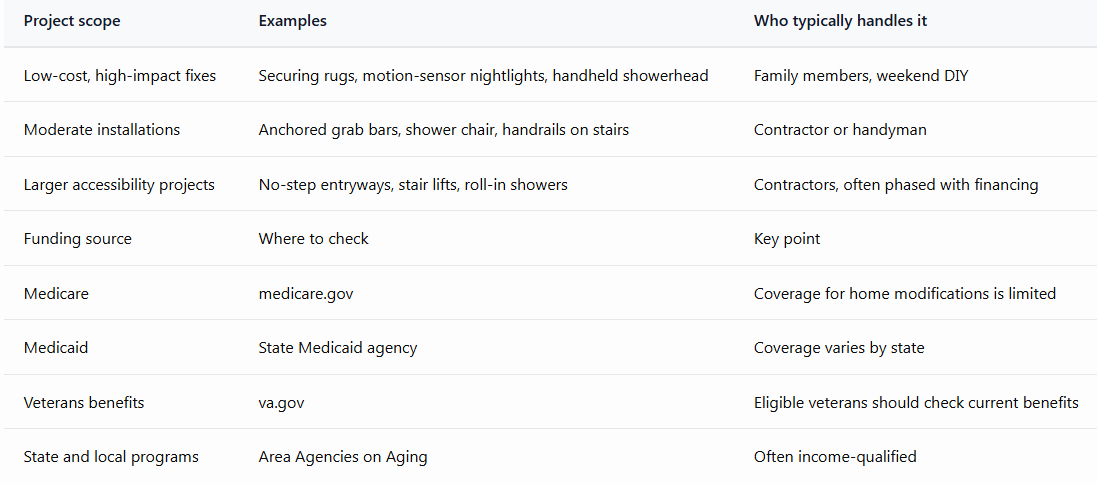
Costs vary by home age, layout, and local labor rates, so no single figure fits every household. What you can do is group projects by scope so you can budget realistically:
Low-cost, high-impact fixes: securing rugs, adding motion-sensor nightlights, installing a handheld showerhead, and clearing walkways. These are weekend projects most families can handle themselves.
Moderate installations: anchored grab bars, a shower chair, a raised toilet seat, and handrails on both sides of stairs. These usually require a contractor or handyman and are the upgrades most often recommended first.
Larger accessibility projects: no-step entryways, stair lifts, roll-in showers, and widened doorways. These are the projects that most often trigger a conversation about financing and phasing.
As a general principle, spending first on fixes that prevent falls is a sensible way to prioritize, since fall-related injuries can be costly.
Funding Sources Families Commonly Use
There is no single program that covers aging-in-place modifications. Families typically piece together several sources:
Medicare: coverage rules for home modifications and non-medical in-home help are specific and limited. Check the official Medicare website (medicare.gov) or speak with a Medicare representative to confirm what is covered.
Medicaid: coverage varies by state. Check your state's Medicaid agency for current home and community-based services options and eligibility.
Veterans benefits: eligible veterans should check with the U.S. Department of Veterans Affairs (va.gov) about current home modification benefits.
State and local programs: many Area Agencies on Aging administer home repair and modification assistance, often income-qualified.
Long-term care insurance: coverage depends on the individual policy; review the policy's specific benefit terms.
Reverse mortgages and home equity: some homeowners use home equity to fund accessibility upgrades, though this deserves careful financial advice.
Watch out: do not assume that Medicare or other programs will cover grab bars or a stair lift. Confirm coverage with the program directly before scheduling work.
Prioritizing by Budget
If the budget is tight, sequence the work in three tiers:
Immediate (this month): fall hazards, lighting, and a way to call for help from every room.
Near-term (this year): bathroom safety, stair handrails, and a clear step-free exit.
Longer-term (as needs change): larger accessibility projects, planned alongside any care-need reassessment.
Ask every contractor for a written estimate and confirm whether the work requires permits. For a detailed look at what families typically pay for in-home care, see this in-home care cost breakdown. Planning ahead gives your family more options than deciding in a crisis, and it lets you spread costs across months instead of absorbing them all at once.
The article groups home modifications by scope and lists the main funding sources families commonly use.
Signs an Aging Parent Needs Help at Home
Families often notice changes gradually. Watch for patterns rather than one-off events. Common signs include:
Recent falls, near-falls, or unexplained bruises
Untidy home, unpaid bills, or spoiled food in the refrigerator
Skipped meals or noticeable weight loss
Trouble with bathing, dressing, or keeping up with medications
Withdrawal from friends, hobbies, or community activities
Loneliness is one of the most overlooked signs. A parent who stops going out or stops answering the phone may be struggling even if the home looks fine. If you notice several of these signs, a conversation about support is worth having sooner rather than later. Companionship, help with daily tasks, and a regular check-in can make a real difference.
Aging in Place Examples: What Works in Real Homes
The most successful arrangements are usually simple. One family may find that moving the bedroom to the ground floor solves most stair problems. Another may add a handrail and motion lights and find that their parent feels more confident walking the house at night. Other households pair modest home changes with part-time in-home help for meals, bathing, or medication reminders.
What these examples share is a plan that changes over time. Needs shift, so reviewing the home and the care arrangement every year or after any health change keeps the plan current.
Planning Your Next Step With Mutiara Elite
Aging in place works best when the home and the support around it fit together. If you are looking for compassionate, non-medical in-home support for a loved one, Mutiara Elite can help you think through what your family needs. Our team focuses on helping people live safely, comfortably, and with dignity in their own homes.
Reach out to Mutiara Elite to talk through your loved one's needs and explore what support could look like at home.
Frequently Asked Questions
What are some tips for aging in place?
Start with a room-by-room safety review. Remove throw rugs, add grab bars in the bathroom and handrails on both sides of stairs, and improve lighting in hallways and at entrances. Clear walking paths so furniture and cords do not create tripping hazards. Next, look at daily routines: where a person sleeps, bathes, cooks, and gets in and out of the house. Adjusting those spaces first usually delivers the biggest gain in safety and independence with the least disruption.
What should be on an aging in place checklist?
A useful aging in place checklist covers entryways, lighting, flooring, bathrooms, kitchen access, stairs, and storage. Check whether the front entrance can be reached without steps, whether light switches are reachable from the bed and doorways, and whether frequently used items sit between shoulder and waist height. Add a review of emergency access, such as a working phone within reach and a plan for who to call. Revisit the checklist every few months, since needs change.
What home modifications help older adults age in place?
Common modifications include grab bars near the toilet and in the shower, a walk-in or curbless shower, lever-style door handles, non-slip flooring, and motion-activated night lights. Entryway changes such as a ramp or a no-step entry can matter a great deal for someone with limited mobility. Many of these changes are low cost, while others require contractor work. Compare options by how much they reduce fall risk for the specific person living in the home.
How do you know when an older adult needs help at home?
Common signs include missed medications, unpaid or overdue bills, unexplained bruises, a decline in personal hygiene, spoiled food in the refrigerator, falls or near-falls, and withdrawal from usual activities. Changes in driving, weight loss, or confusion about routine tasks also deserve attention. Start a conversation without judgment, observe over several visits, and consider a professional evaluation if the pattern continues. Non-medical in-home support can help with daily tasks while the family plans next steps.
How does aging in place compare with assisted living?
Aging in place keeps a person in their own home, with changes made to support safety and independence. Assisted living places a person in a community setting with staff available around the clock and shared services. Many people prefer to stay home for familiarity and control, while others need the structure a community provides. The right choice depends on care needs, budget, social preferences, and how the home can be adapted. Consider a professional assessment to compare the two options for a specific situation.