

Editorial Team· Content Writer
Nov 4, 2026 15 min read 2,931 words
Quick Summary
Families can finance elder care by first mapping the loved one's needs and budget, then checking insurance, Medicare, Medicaid, and long-term care policies, and combining income, savings, family contributions, and benefits screening. Home equity options such as reverse mortgages can help when other sources fall short. Start by confirming which care setting is needed and how urgently.
Write down weekly care needs and total what the family can realistically contribute each month.
Standard health insurance usually does not cover non-medical custodial home care.
Medicaid HCBS waivers may fund home care but often have waitlists, so apply early.
Put family cost-sharing arrangements in writing, covering who pays what and how often.
Benefits screening through a local Area Agency on Aging can reveal programs you may qualify for.
How will you cover the cost of care?
Mutiara Elite offers personalized, non-medical in-home support that helps loved ones live safely at home. Talk to Our Care Team.
Table of Contents
Why Paying for Elder Care Feels So Hard
Most families reach the point of needing care without a plan for paying for it, and a clear approach to finance elder care can make the decision far less stressful. One day a parent needs help bathing, medication reminders or a ride to appointments, and the question of money arrives before anyone has had time to think it through.
The expense of caregiving is real, and it helps explain why so many households feel stretched (2021 Caregiving Out-of-Pocket Costs Study).
Finding the money to finance elder care is only part of the challenge. Families also have to decide which type of care fits the person's needs, how urgently help is required, and which resources are available to pay for it.
Start With a Clear Picture of Your Loved One's Needs and Budget
Before you look at any payment option, write down what your loved one needs each week. Our In-Home Care Cost Breakdown: What Families Pay shows what typical in-home care costs look like, so you can estimate the budget you'll need. List the daily living tasks that require help, such as bathing, dressing, meals, transportation and medication management.
Flowchart illustrating the steps to manage finance elder care by reviewing budget needs with a loved one.
Next, total up what the family can realistically contribute each month. Include retirement income, savings, and any regular payments the person already receives. The gap between those two numbers is your funding gap, and it tells you how much outside support you need to find.
Keep the list in one place and update it every few months. Care needs often change, and a plan built on last year's situation can quickly stop working.
Does Insurance Cover Home Care Services?
Many families assume health insurance will pay for in-home help, but standard coverage is often narrower than people expect. The key distinction is between skilled, medical services and custodial, non-medical care. Insurance generally pays for the first and rarely pays for the second. Non-medical home care, companionship, housekeeping, meal preparation, bathing and dressing assistance, medication reminders, and transportation, is usually classified as custodial care and falls outside standard health plans.
Before you build a budget around insurance, pull the policy documents and call the insurer with three specific questions: Which home care services are covered? Is there a prior-authorization or physician-order requirement? Is there a visit or hour limit per benefit period? A benefits counselor at your local Area Agency on Aging can help you read the fine print, and your loved one's doctor can confirm whether any services would qualify as skilled.
Medicare's Actual Home Health Rules
Medicare, the federal health insurance program primarily for adults 65 and older, generally does not pay for long-term custodial care at home (Home Health Services Coverage). It may cover skilled home health services when the conditions below are met. Check the official Medicare website for current rules:
A doctor certifies that your loved one needs skilled care and orders a plan of care.
The need is part-time or intermittent, not full-time custodial support.
Your loved one is homebound, meaning leaving home requires considerable effort or is medically contraindicated.
The care is provided by a Medicare-certified home health agency.
Coverage is limited and does not usually extend to ongoing help with daily living tasks once the skilled need ends. Confirm current requirements with the official Medicare source.
Medicaid and State-Based Long-Term Care
Medicaid, jointly funded by the federal government and administered by each state, is a major payer of long-term care (Long Term Services & Supports). It may cover in-home and community-based long-term care for people who meet both functional eligibility (a level-of-care assessment showing the person needs nursing-facility-level or waiver-level support) and financial eligibility (income and asset limits that vary by state).
Two mechanisms matter most for families:
Home and Community-Based Services (HCBS) waivers. These waivers let states pay for care at home or in community settings instead of in an institution. Waiver programs often have waitlists, so applying early matters even if care is not needed yet.
Spousal impoverishment protections. Federal rules may protect part of a couple's income and assets for the spouse who remains at home. Confirm current protections with your state Medicaid office.
Eligibility rules, waiver availability, and asset limits differ significantly by state. Contact your state Medicaid office or your local Area Agency on Aging for current details, and ask specifically about waiver waitlists and the level-of-care assessment process.
Long-Term Care Insurance
Long-term care insurance is designed to help pay for extended support, such as in-home care, assisted living, and nursing facilities, depending on the policy. Policies differ widely in benefit amounts, elimination periods (the waiting period before benefits begin), daily or monthly benefit maximums, and whether they cover non-medical services. If your loved one already holds a policy, check three things before you plan around it:
Benefit triggers. Most policies pay when the policyholder cannot perform a set number of activities of daily living (such as bathing, dressing, eating, toileting, transferring, and continence) without help, or has a cognitive impairment. Confirm the exact trigger language.
Elimination period. This is the number of days you pay out of pocket before benefits start. A 90-day elimination period means three months of self-funding.
Inflation protection and benefit period. A policy without inflation protection may cover far fewer years of care than the family expects.
Coverage generally has to be purchased before care is needed, so it rarely solves an immediate problem. If a policy exists but the insurer disputes the claim, ask for the denial in writing and request the policy's internal appeal process; your state's insurance department can also explain complaint options.
How to Pay for Nursing Home Care With Social Security
Social Security benefits are a common income source for older adults, and some families use them to help cover care costs. A representative payee arrangement may allow a family member to manage the funds in some situations.
If your loved one receives Supplemental Security Income, the rules for using that income for care may differ. Confirm the details with the Social Security Administration before making commitments.
How to Pay for Long-Term Care Without Insurance
Families without long-term care insurance can still build a workable plan, but the right mix depends on three variables: care setting, urgency, and which assets are liquid. Most guides list payment methods without helping families choose among them. Use the framework below to decide what to investigate first, then read the trade-offs before committing.
A Decision Framework: Setting, Urgency, and Liquidity
Step 1, Name the care setting. In-home non-medical care, assisted living, and nursing facility care have different funding paths. In-home care is often paid from income and savings plus family contributions; assisted living is frequently private-pay; nursing facility care is where Medicaid becomes most relevant after a spend-down. Confirm the setting before you apply for anything.
Step 2, Gauge urgency. If care is needed this month, prioritize options that produce cash quickly: current income, savings, family contributions, and short-term financing. If you have months to plan, prioritize benefits screening, waiver applications, and home equity options, which take longer to arrange.
Step 3, Inventory liquid versus illiquid assets. Liquid assets (checking, savings, retirement accounts, brokerage accounts) can be tapped quickly but may carry tax consequences. Illiquid assets (a home, a vehicle, personal property) require a sale, a loan, or a reverse mortgage and take longer.
The Main Funding Sources and Their Trade-Offs
Personal savings, income, and retirement assets. Retirement accounts, pensions, and savings can be drawn down gradually. Plan withdrawals carefully, because large distributions can have tax consequences. Coordinate withdrawals with a tax professional.
Family cost-sharing. Siblings or other relatives can divide monthly expenses or take turns covering specific bills. Put the arrangement in writing: who pays what, how often, what happens if one person cannot contribute, and how the contribution is documented. A simple written agreement prevents the misunderstandings that strain families later. Some families also formalize a caregiver arrangement so that an adult child providing care is compensated, which can have tax and Medicaid-planning implications worth discussing with a professional.
Part-time or phased care. Starting with a few hours a week and increasing support as needs grow can spread costs over time. This works best when the care setting is home and the family can fill gaps.
Benefits screening. State and local programs, veterans' benefits, and community aid sometimes cover part of the expense. A local Area Agency on Aging can point you toward programs you may qualify for, and the Eldercare Locator can connect you to the right local agency. Veterans and surviving spouses should ask about available VA benefits and programs.
Home equity and short-term financing. A reverse mortgage, home equity line of credit, or bridge loan can convert home equity into cash. These are covered in more detail in the next section.
What to Investigate First
If care is needed within 30 days, start with current income and savings, then ask family members for commitments, then explore short-term financing. If you have 60 to 90 days, add a benefits screening through your Area Agency on Aging and ask your state Medicaid office about waiver waitlists. If you have six months or more, add home equity options and a tax review of retirement withdrawals. Document every application and keep copies, benefit programs frequently ask for the same income and asset information more than once.
Using Home Equity and a Bridge Loan for Senior Living
If your loved one owns a home, its equity can be a significant funding source. A reverse mortgage lets eligible older homeowners convert part of their home equity into cash, while a home equity line of credit or a bridge loan may be used to cover costs during a transition. Each product has different requirements, fees and risks, and a reverse mortgage can reduce the equity left for heirs.
A bridge loan is short-term financing, often used when a home must be sold to fund senior living but the sale has not yet closed. These loans typically carry higher interest rates, so they are best used for a defined period with a clear repayment plan. Before choosing any of these options, consult a HUD-approved housing counselor and a financial advisor who can review the full terms.
Comparing Your Options: Care Settings, Urgency and Assets
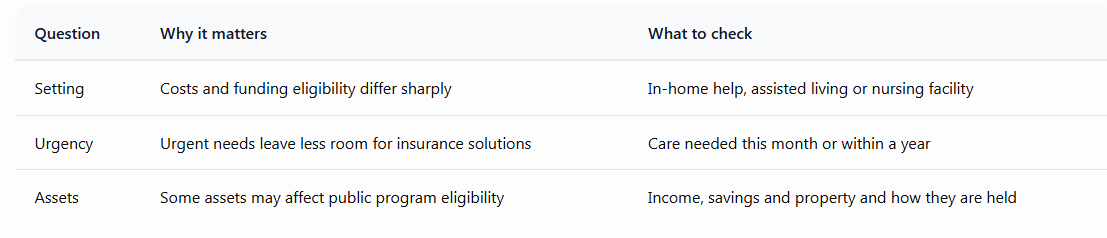
No single funding source fits every family. The right mix depends on the care setting you need, how quickly you need it, and what assets are available. Consider these questions as you compare:
Setting: Does your loved one need in-home help, assisted living or a nursing facility? Costs and funding eligibility differ sharply between them.
Urgency: Is care needed this month, or can you plan over the next year? Urgent situations usually leave less room for insurance-based solutions.
Assets: What income, savings and property are available, and how are they held? Some assets may affect eligibility for public programs.
Many families find that combining two or three sources works better than relying on one. You can review our non-medical home care services, including companionship and respite care, to see how in-home support fits into that mix. For example, Social Security income might cover part of the monthly bill, while savings and family contributions cover the rest. In-home, non-medical care from a provider such as Mutiara Elite, which offers personalized support so loved ones can live safely at home, can be one part of that mix. Other providers may offer different service models, so compare costs and services directly before you decide.
The right funding mix depends on three questions you can work through before committing to any option.
Planning Your Next Step to Fund Care for Your Loved One
Start with the list you made of your loved one's needs and your available resources. Then contact the benefits offices that apply to your situation, including your state Medicaid office and your local Area Agency on Aging, to confirm current eligibility rules. Ask your loved one's insurer which services are covered, and consult a financial advisor if you are considering home equity options.
When you are ready to talk about care options and what they might look like for your family, reach out to Mutiara Elite. Our team can discuss personalized in-home support and answer your questions. Our service is built on the belief that care should feel as precious as family, and that your loved one deserves dignity in their own home.
Frequently Asked Questions
How does anyone afford elder care?
Most families combine several sources rather than relying on one. Common options include the older adult's own income such as Social Security and pensions, personal savings, long-term care insurance if it was purchased earlier, and public programs like Medicaid, which has strict income and asset limits that vary by state. Some families also contribute to costs together, sharing monthly expenses among siblings or relatives. A benefits check and a written budget are useful first steps, because they show the real funding gap that needs to be covered.
Does insurance cover non-medical home care services?
Coverage depends on the policy and the type of care. Standard health insurance and Medicare generally do not pay for non-medical, custodial help with daily activities such as bathing, meals or companionship. Long-term care insurance is designed for these services and may cover them, but only after the policy's waiting period and benefit terms are met. Medicaid coverage for home-based services varies by state. Check the specific policy language or contact the program directly before assuming any coverage.
Can Social Security help pay for nursing home care?
Social Security benefits are paid to the older adult and can be used toward nursing home care, assisted living or in-home support. Supplemental Security Income (SSI) is a separate program with strict income and resource limits, and eligibility rules differ from standard retirement benefits. Families often direct Social Security income toward a monthly care bill, and a representative payee arrangement may be needed if the older adult cannot manage payments. The Social Security Administration website and local benefits counselors can confirm current rules.
How can you pay for long-term care without insurance?
Families without long-term care insurance usually rely on a mix of income, savings, home equity and public assistance. Options include using pension and retirement account withdrawals, downsizing a home, taking a reverse mortgage or home equity line of credit, and applying for Medicaid if assets and income qualify. Some families also arrange private pay agreements with providers. Each option has trade-offs, including tax consequences and effects on eligibility for public benefits, so reviewing them with a financial planner or elder law attorney is worthwhile.
What is a bridge loan for senior living?
A bridge loan is short-term financing that covers the gap between paying for senior living and receiving funds from another source, such as the sale of a home. It is usually secured by the older adult's property and carries interest and fees. Because it must be repaid, it suits families who expect a clear source of repayment soon. Compare the total cost with other options, and confirm the terms in writing before committing.
What should a family do first when care costs are not affordable?
Start by listing the older adult's monthly income, savings, property and current care needs. Then review benefits the person may qualify for, including Medicare, Medicaid, Social Security, and any veterans or state programs. Next, speak with a benefits counselor, such as an Area Agency on Aging, and consider an elder law attorney for estate and eligibility questions. Taking these steps before a crisis gives families more choices and more time to plan.